Table of Contents
Highway projects construction requires materials that can meet demanding structural specifications, construction schedules and quality-control requirements. Reinforced concrete is widely used in highway-related structures such as bridges, culverts, retaining structures, drainage structures, foundations, approach structures and other RCC components.
For these applications, reinforcement steel is a critical material.
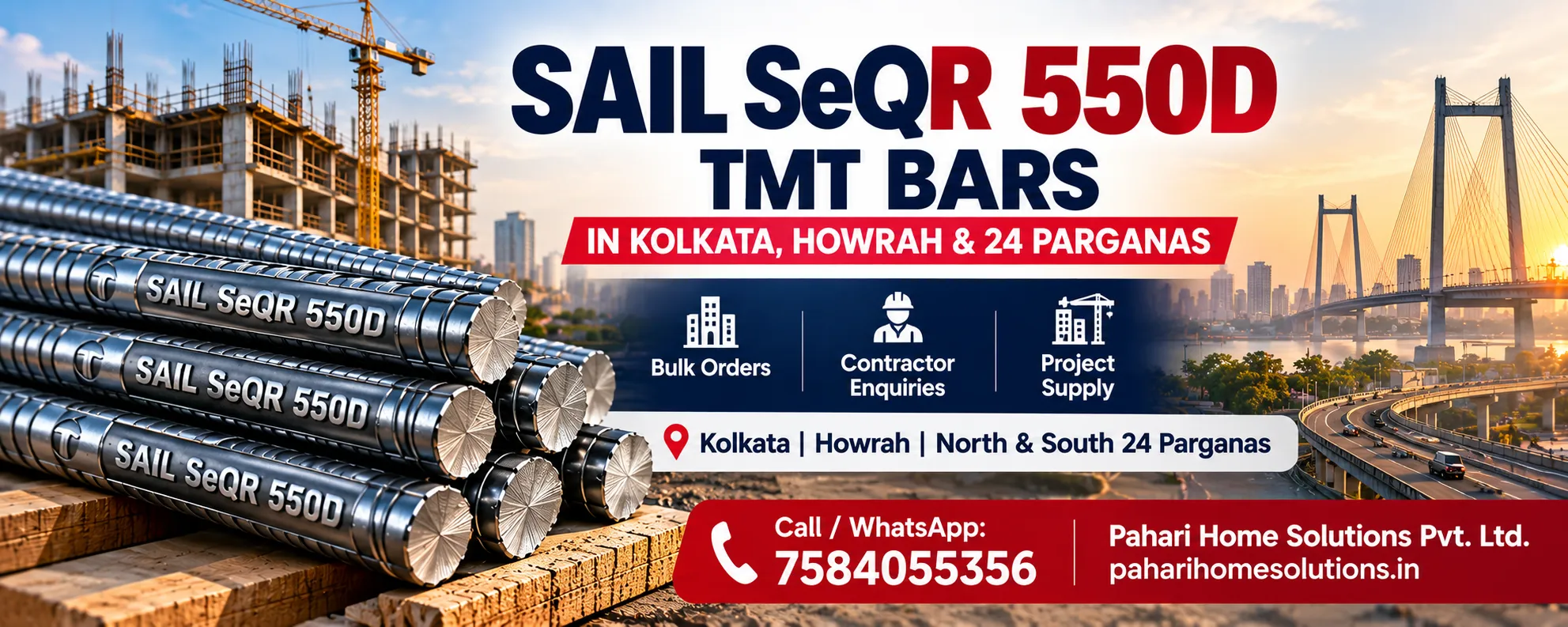
SAIL SeQR 550D TMT Bars are a high-strength, ductile reinforcement option from the Steel Authority of India Limited (SAIL). SAIL’s published product information identifies SeQR as a Fe-550D TMT product and highlights strength, ductility, bendability, rib pattern and steel quality among its characteristics.
For contractors, infrastructure companies, builders and project procurement teams working across Purba Medinipur, Paschim Medinipur, Jhargram and adjoining areas of West Bengal, understanding the product and the requirements of bulk TMT supply can be important when planning highway projects and infrastructure projects.
This guide explains the characteristics of SAIL SeQR 550D, its potential applications in highway-related RCC construction, important buying considerations and what project buyers should check before placing bulk orders.
What Is SAIL SeQR 550D TMT Bar?
SAIL SeQR is a branded TMT reinforcement product from the Steel Authority of India Limited (SAIL).
The current SAIL website describes SeQR TMT Bars as a high-strength reinforcement product designed for modern construction and infrastructure requirements. SAIL highlights a combination of strength and flexibility and positions the product for structural applications where these characteristics are important.
SAIL’s published technical brochure identifies SAIL SeQR Fe-550D with a minimum yield strength of 550 MPa, a minimum total elongation of 16%, and a minimum UTS/YS ratio of 1.15 as typical product values in the brochure.
The exact grade, diameter and technical requirements for a highway projects should always be determined by the project’s approved structural drawings, specifications and applicable standards.
What Does 550D Mean?
Understanding the 550 Grade
The “550” in Fe-550D refers to the nominal minimum yield strength class of 550 MPa.
Yield strength is an important mechanical property because it indicates the stress level at which the steel begins to undergo permanent deformation.
For comparison, SAIL’s published technical information lists Fe-500D at a minimum yield strength of 500 MPa and Fe-550D at 550 MPa.
Understanding the D
The “D” designation refers to enhanced ductility requirements compared with the corresponding non-D grade.
Ductility matters because reinforcement steel should have the ability to deform under increasing loads rather than failing suddenly.
For highway projects and infrastructure structures that may experience variable, dynamic or seismic loading, ductility can therefore be an important consideration alongside strength.
Key Properties of SAIL SeQR 550D
High Yield Strength
SAIL SeQR 550D is specified in the Fe-550D strength class.
SAIL’s technical brochure lists:
- Minimum yield strength: 550 MPa
- Minimum total elongation: 16%
- Minimum UTS/YS ratio: 1.15 as a typical SeQR value in the published brochure
These characteristics distinguish the product from standard lower-strength reinforcement grades.
High Ductility
Ductility is particularly relevant when reinforcement is expected to undergo deformation under demanding loading conditions.
SAIL highlights the high UTS/YS ratio and ductility of SeQR TMT bars as product attributes associated with plastic energy absorption.
However, the structural performance of a highway or bridge is determined by the complete engineered system—not by reinforcement grade alone.
Bendability
Highway projects involve extensive reinforcement fabrication.
Bars may need to be bent into:
- Stirrups
- Column reinforcement
- Beam reinforcement
- Footing reinforcement
- Pier reinforcement
- Retaining-wall reinforcement
- Drainage and culvert reinforcement
SAIL’s product information highlights bendability and rebendability as attributes of SeQR TMT bars.
Actual bending should always follow the approved bar-bending schedule and applicable construction standards.
Ribbed Surface
TMT bars have a ribbed surface designed to provide mechanical interaction with concrete.
SAIL identifies its SeQR rib pattern as an attribute intended to provide high bonding properties with concrete.
Good reinforcement-concrete interaction is essential for transferring stresses effectively within RCC structures.
Steel Chemistry
SAIL’s published SeQR technical data lists typical maximum values of:
- Carbon: 0.25%
- Sulphur: 0.035%
- Phosphorus: 0.035%
- Sulphur + Phosphorus: 0.070%
The brochure also compares these values with the applicable Fe-550D requirements in its product table.
For project procurement, the relevant test certificates and supplied material documentation should be checked against the project’s specifications.
Why Can 550D TMT Bars Be Considered for Highway Projects?
Highway construction is not limited to the road surface itself.
Large highway packages can involve numerous RCC structures.
Bridges
Reinforcement steel is required in various bridge components, depending on the design, such as:
- Foundations
- Pile caps
- Piers
- Abutments
- Deck-related RCC components
- Approach structures
Culverts
RCC box culverts and other drainage structures can require substantial quantities of reinforcement steel.
Retaining Structures
Road widening, embankments and changes in ground level can require retaining walls and other reinforced structures.
Drainage Structures
Side drains, cross-drainage structures and related RCC elements may also require reinforcement.
Roadside Infrastructure
Depending on the project design, RCC can be used for:
- Foundations
- Utility structures
- Barriers
- Drainage structures
- Signage foundations
- Other civil works
The actual reinforcement grade and diameter must be determined from the approved design.
SAIL SeQR 550D for Bridge Construction
Bridge construction places significant demands on structural materials.
Depending on the engineering design, reinforcement may be required in:
Foundations
Deep foundations, pile caps and other substructure elements may contain large reinforcement cages.
Piers
Bridge piers require carefully detailed reinforcement to resist the loads transmitted from the superstructure.
Abutments
Abutments transfer loads and retain approach fills, making reinforcement detailing particularly important.
RCC Components
Various bridge-related RCC components may use reinforcement bars of different diameters and grades.
For each component, the contractor must follow the structural drawings and approved bar-bending schedules.

SAIL SeQR 550D for Highway Culverts
Culverts are important components of highway projects drainage systems.
A poorly designed or poorly constructed culvert can affect water flow, road embankment stability and long-term maintenance.
Reinforcement can be used in:
- RCC box culverts
- Slab culverts
- Headwalls
- Wing walls
- Aprons
- Drainage structures
SAIL SeQR 550D can be considered where the project specification calls for the relevant Fe-550D reinforcement grade.
SAIL SeQR 550D for Road Infrastructure
Highway projects often involve multiple RCC structures beyond bridges and culverts.
Depending on the project, these may include:
- Retaining walls
- Drainage channels
- Underpasses
- Pedestrian structures
- RCC barriers
- Foundations
- Service structures
A high-strength reinforcement grade can be useful where it is selected as part of the structural design.
Strength vs Ductility: Why Both Matter
One of the biggest mistakes in TMT selection is looking only at yield strength.
Strength
Higher yield strength means the steel can withstand a higher stress level before yielding.
Ductility
Ductility describes the capacity of the steel to deform before failure.
Why the Combination Matters
For infrastructure projects, engineers may need reinforcement that combines:
Strength + Ductility + Bendability + Bonding + Consistent Quality
SAIL positions SeQR around this combination rather than strength alone.
Is Fe-550D Automatically Better Than Fe-500D?
Not necessarily.
A higher grade is not automatically the correct choice for every highway projects.
The project engineer may specify a particular grade based on:
- Structural calculations
- Design codes
- Seismic considerations
- Load requirements
- Member dimensions
- Reinforcement congestion
- Construction methodology
- Project specifications
- Client requirements
Therefore, contractors should never replace one specified TMT grade with another solely because it has a higher strength rating.
Potential Benefits of High-Strength Reinforcement
High-strength reinforcement can offer potential design advantages when properly incorporated into the structural design.
Reduced Reinforcement Requirement
For certain designs, higher-strength steel can allow optimization of reinforcement quantity.
Lower Reinforcement Congestion
Where reinforcement quantities can be optimized, congestion inside heavily reinforced structural members may potentially be reduced.
Efficient Structural Design
High-strength reinforcement can provide designers with greater flexibility when optimizing structural members.
SAIL’s own SeQR product literature identifies lower steel weight, reduced reinforcement congestion and increased flexibility among the potential advantages of its higher-strength TMT offering.
These are design-dependent benefits, not guaranteed savings on every project.
West Bengal Highway Projects Construction: Why Location Matters
West Bengal has a diverse range of construction environments.
Highway projects in coastal Purba Medinipur can face different environmental conditions from a project around Jhargram or inland Paschim Medinipur.
Purba Medinipur
Major locations include:
- Tamluk
- Haldia
- Contai
- Egra
- Digha
- Panskura
- Mecheda
Highway projects and infrastructure projects in the district may include road improvements, bridges, drainage works and connectivity projects.
Paschim Medinipur
Important areas include:
- Midnapore
- Kharagpur
- Ghatal
- Belda
- Keshiary
- Debra
The district has significant road and infrastructure requirements connecting urban, industrial and rural areas.
Jhargram
Important areas include:
- Jhargram
- Gopiballavpur
- Nayagram
- Binpur
- Belpahari
Projects in this region can involve road infrastructure through varied terrain and environmental conditions.
Coastal Construction and TMT Durability
For projects around coastal Purba Medinipur, environmental exposure deserves particular attention.
Locations such as Digha, Mandarmani, Tajpur and Contai can experience humid conditions and coastal salt exposure.
However, choosing a high-strength TMT bar does not by itself make an RCC structure corrosion-proof.
Long-term reinforcement durability also depends on:
- Concrete quality
- Water-cement ratio
- Concrete cover
- Compaction
- Curing
- Crack control
- Drainage
- Waterproofing
- Exposure conditions
For aggressive exposure environments, the project consultant should specify appropriate durability measures.
SAIL SeQR 550D Sizes
SAIL’s published SeQR product brochure lists a 12-metre nominal length and the following rationalised sizes in its product table:
| Nominal Diameter | Approx. Weight per Metre |
|---|---|
| 8 mm | 0.395 kg/m |
| 10 mm | 0.617 kg/m |
| 12 mm | 0.888 kg/m |
| 16 mm | 1.58 kg/m |
| 20 mm | 2.47 kg/m |
| 25 mm | 3.85 kg/m |
These are product-brochure figures and actual supply should be verified against the purchase specification and relevant documentation.
Other SAIL manufacturing facilities and product listings show broader TMT size ranges for different product categories, so project buyers should confirm the exact size availability for the required SeQR grade.
TMT Bar Requirement for Highway Projects
Bulk highway projects can require significant quantities of reinforcement.
Before placing an order, procurement teams should prepare a detailed material requirement.
Check the Bar-Bending Schedule
The BBS should establish:
- Bar diameter
- Bar shape
- Bar length
- Number of bars
- Bending details
- Total weight
Check Structural Drawings
The reinforcement order should match the latest approved structural drawings.
Consider Construction Phases
Large projects may require staged deliveries instead of one-time delivery.
Plan Storage
Adequate space should be available at the project site to store incoming steel safely.
Bulk TMT Bar Project Supply
For infrastructure projects, procurement is different from buying steel for an individual house.
A project supplier may need to coordinate:
Requirement → Quotation → Grade Confirmation → Quantity → Delivery Schedule → Site Receiving → Documentation
This becomes particularly important when multiple work fronts are operating simultaneously.
What Should Contractors Check Before Ordering?
1. Grade
Confirm that the required grade is Fe-550D or the exact grade specified in the tender/project documentation.
2. Diameter
Verify the required diameter-wise quantities.
3. Quantity
Prepare a bar-diameter-wise material schedule.
4. Test Certificates
Request the relevant material test documentation where required by the project specification.
5. Batch Information
Maintain batch and delivery records for traceability.
6. Delivery Schedule
Coordinate deliveries with the construction programme.
7. Unloading
Plan suitable unloading equipment and storage arrangements.
How to Verify Genuine SAIL SeQR 550D
For a major project, material verification should not be treated casually.
Check Bar Markings
Inspect the physical markings on the bars for manufacturer/product identification.
Check Grade
Confirm that the supplied material corresponds to the ordered grade.
Check Documentation
Maintain:
- Purchase invoice
- Delivery challan
- Test certificates
- Batch information
- Quantity records
Inspect the Material
Check for:
- Excessive corrosion
- Severe pitting
- Physical damage
- Incorrect diameter
- Bent or damaged bars
Any questionable material should be referred to the project’s quality-control or engineering team.
Storage of TMT Bars at Highway Projects Sites
Highway projects often operate for months or years, making storage important.
Keep Steel Off the Ground
Use sleepers or suitable supports.
Prevent Water Accumulation
Avoid locations where rainwater collects around the reinforcement.
Separate Different Diameters
Organize bars according to diameter and grade.
Maintain Identification
Keep batch and material identification intact after unloading.
Protect Project Records
Match material receipts with invoices and test documentation.
SAIL SeQR 550D for Highway Projects in Purba Medinipur
Purba Medinipur has a combination of urban, industrial, coastal and tourism-linked areas.
Project locations may include:
- Tamluk
- Haldia
- Contai
- Egra
- Digha
- Panskura
- Mecheda
For highway projects contractors working in this region, a reliable TMT supply chain can be important for maintaining project schedules.
Depending on project specifications, SAIL SeQR 550D can be considered for relevant RCC components where Fe-550D reinforcement is specified.
SAIL SeQR 550D for Projects in Paschim Medinipur
Paschim Medinipur includes major construction and connectivity centres such as:
- Midnapore
- Kharagpur
- Ghatal
- Belda
- Debra
- Keshiary
Kharagpur in particular is an important transport and industrial centre, making construction-material supply relevant for a range of infrastructure activities.
For highway projects and civil projects in the district, reinforcement procurement should be aligned with project drawings, specifications and construction schedules.
SAIL SeQR 550D for Jhargram Projects
Jhargram presents a different geographical environment, with roads passing through forested, rural and varied-terrain areas.
Major areas include:
- Jhargram
- Gopiballavpur
- Nayagram
- Binpur
- Belpahari
Highway and road infrastructure in such regions may involve bridges, culverts, drainage structures, retaining structures and other RCC components.
The appropriate TMT grade should be selected according to the approved engineering design.
Project Supply vs Individual House Supply
The requirements of an infrastructure contractor and an individual homeowner are very different.
| Factor | Individual House | Highway Projects |
|---|---|---|
| Quantity | Relatively smaller | Potentially very large |
| Procurement | One/few orders | Multiple scheduled deliveries |
| Documentation | Basic purchase records | Detailed project documentation |
| Grades | Engineer specified | Tender/design specified |
| Sizes | Limited range | Multiple diameters |
| Delivery | Single/few deliveries | Phased delivery |
| Quality Control | Basic inspection | Formal project QC requirements |
| Storage | Smaller area | Dedicated steel storage area |
This is why project-oriented TMT supply requires more planning than ordinary retail steel purchases.
Why Choose a Reliable Project TMT Supplier?
For highway projects and infrastructure projects, price is only one part of procurement.
A reliable supplier should ideally be able to support:
- Required grade availability
- Multiple bar diameters
- Bulk quantities
- Scheduled delivery
- Proper billing
- Material documentation
- Communication with contractors
- Site-specific delivery coordination
SAIL itself states that its SeQR products are marketed through a distributor-dealer network across India, supporting availability in multiple markets.
Project Supply from Pahari Home Solutions
Pahari Home Solutions is a construction-material supplier serving homeowners, contractors, builders and project buyers.
For projects requiring TMT reinforcement, customers can enquire about the availability of leading brands and grades according to their project requirements.
TMT Bar Brands
Depending on current availability and project requirements, options can include:
- SAIL SeQR
- Tata Tiscon
- JSW Neosteel
- Jindal Panther
- Other leading TMT brands
Construction Material Categories
Pahari Home Solutions also deals in construction products such as:
- Cement
- TMT Bars
- Structural Steel
- MS Pipes
- Angles
- Channels
- Tiles
- Paints
- Waterproofing Products
- Sanitaryware
- Bath Fittings
For bulk project requirements, buyers should provide the required grade, diameter, quantity, delivery location and expected delivery schedule to receive an appropriate quotation.
Frequently Asked Questions
What is SAIL SeQR 550D TMT Bar?
SAIL SeQR 550D is a Fe-550D class TMT reinforcement product from the Steel Authority of India Limited. SAIL publishes a minimum yield strength of 550 MPa for its SeQR Fe-550D product.
Is SAIL SeQR 550D suitable for highway construction?
It can be used for highway-related RCC structures where the approved structural design and project specifications call for Fe-550D reinforcement.
Can SAIL SeQR 550D be used in bridges?
Yes, it can be considered for bridge-related RCC components where the project’s engineering specifications permit or specify the grade. The exact reinforcement grade and diameter must be determined by the structural design.
Can it be used for culverts?
Yes, Fe-550D reinforcement can be used in RCC culverts where specified by the project’s structural design.
Is 550D better than 500D?
550D has a higher nominal yield-strength class than 500D, but “better” depends on the structural design. A higher grade should not be substituted without engineering approval.
Does SAIL SeQR 550D reduce steel consumption?
Higher-strength reinforcement can allow reinforcement optimization in appropriate structural designs. SAIL identifies reduced steel weight and reinforcement congestion among potential benefits of SeQR.
Actual savings depend on the structural design and should be calculated by the project’s structural engineer.
Is SAIL SeQR 550D corrosion-proof?
No TMT grade should be treated as making an RCC structure automatically corrosion-proof. Durability depends on reinforcement quality as well as concrete cover, concrete quality, curing, crack control, drainage and environmental exposure.
What sizes of SAIL SeQR 550D are available?
SAIL’s published SeQR brochure lists 8, 10, 12, 16, 20 and 25 mm rationalised sizes with a 12-metre nominal length. Availability should be confirmed for the specific project and market.
Where can I source SAIL SeQR TMT Bars for a project?
SAIL markets SeQR through its distributor-dealer network. Project buyers can also approach established construction-material suppliers for current availability, quantities and delivery options.
Can individual homeowners buy SAIL SeQR 550D?
Yes, where the required grade is available and specified by the structural design. Homeowners should purchase according to the engineer’s reinforcement schedule rather than selecting a grade independently.
Can SAIL SeQR 550D be used in coastal West Bengal?
It can be considered where specified, but coastal construction requires appropriate durability design. Concrete cover, concrete quality, curing, waterproofing, drainage and exposure-specific requirements are important in addition to the reinforcement grade.
Conclusion
SAIL SeQR 550D TMT Bars are a high-strength, ductile reinforcement option that can be considered for highway projects and infrastructure construction when the project design specifies Fe-550D reinforcement.
SAIL’s published product information highlights a 550 MPa minimum yield-strength class, high ductility, bendability and rib-pattern characteristics, while its technical documentation provides product-specific mechanical and chemical data.
For highway projects, however, selecting a TMT bar is only the beginning. Successful reinforcement procurement also requires accurate quantity planning, diameter-wise ordering, quality documentation, proper storage, scheduled delivery and compliance with the project’s structural specifications.
This is particularly important for large infrastructure projects across Purba Medinipur, Paschim Medinipur and Jhargram, including construction activity around Tamluk, Haldia, Contai, Egra, Digha, Panskura, Mecheda, Midnapore, Kharagpur, Ghatal, Belda and Jhargram.

For contractors, builders and infrastructure companies looking for TMT bars and other construction materials, Pahari Home Solutions can be approached for product availability and project-supply requirements.
Pahari Home Solutions — One Stop Solution for All Your Construction Needs.